The pricing strategy is finalized. The sales team is trained. The marketing campaign is ready to launch. And then, someone asks: "Can the billing system actually handle this?"
The answer may often be some version of "not yet." Maybe the development team needs four to six weeks to configure the new rate structure. Maybe the legacy system doesn't support usage-based tiers without a custom build. Maybe a partner needs to be looped in, contracts signed, timelines shifted. And just like that, a well-planned product launch slips by a quarter.
This isn't a rare edge case. For companies in telecom, SaaS, utilities, and IoT, the billing system has quietly become one of the most consequential and most underestimated bottlenecks to growth. It's not mentioned in product roadmaps or board decks. It doesn't show up on competitive analysis slides. But when it breaks down, the entire business slows with it.
What Is a Billing Bottleneck?
A billing bottleneck occurs when a company's billing software cannot support its pricing models, new product offers, product velocity, or transaction volume. It's a slow, compounding constraint, a gap between what your business needs to do and what your billing system is capable of supporting.
Billing is perceived as a backend function, a finance and IT concern. It's the plumbing of the business: invisible when it works, catastrophic when it doesn't. So organizations tend to treat it reactively, patching problems as they emerge rather than proactively investing in infrastructure that enables growth.
But this perception is increasingly costly. As product and pricing models grow more complex, the billing system is no longer just processing transactions. It's enforcing your business rules / model. And when the system can't support the business rules / model you need to run, the business adapts to the system instead of the other way around.
That's the billing bottleneck: not a single point of failure, but a slow, compounding constraint on your ability to compete.
6 Signs Your Billing System Is Holding Back Product Growth
The symptoms of a billing bottleneck are rarely dramatic. They tend to look like organizational friction, e.g., delays, workarounds, manual interventions, that get absorbed into normal operations without anyone questioning the root cause.
Here are the six most common signs:
1. New product launches consistently slip their deadlines.
Every new pricing structure or bundle requires development work on the billing side. In organizations running legacy systems, this can mean cumbersome effort for changes. Meanwhile, the market opportunity has a shelf life.
2. Promotional pricing requires manual management.
A limited-time offer sounds simple. But if the billing system can't automatically apply promotional rates and revert to standard pricing when the promotion ends, someone has to manage it by hand, manually adding and removing it. Mistakes happen. Customers get overcharged. Disputes follow.
3. Cross-selling is limited by what can be invoiced.
Sales teams can only sell what the billing system can actually bill. If combining two services into a single invoice requires a custom development project, the bundle simply doesn't get offered. Revenue opportunities are left on the table, not because of lack of demand, but because of lack of billing flexibility.
4. Shared usage models are too complex to implement.
Whether it's a shared data pool for a corporate mobile plan, a multi-tenant IoT deployment, or split billing across a business unit, the ability to allocate and apportion charges is a prerequisite for entire categories of modern products. When a billing system cannot handle this complexity, these offerings simply do not reach the market.
5. Pricing changes are slow and risky.
When a rate structure lives inside a rigid system, changing it means touching core infrastructure, rewriting your entire rate plan, and often leads to duplication of price lists. That creates operational and financial risk leading to lengthy testing and change control processes before updates can go live. By the time a pricing change makes it through the cycle, your customers may have already moved on to a competitor.
6. Limited reporting restricts commercial decision-making.
Without clear visibility into usage patterns, organizations struggle to analyze costs, negotiate international traffic agreements, or optimize spending. B2B customers also expect detailed, real-time consumption and balance reporting. Without these capabilities, both providers and enterprises face reduced operational efficiency and weaker cost control.
None of these are fatal on their own. But together, they create an organization that's systematically slower than it should be: slower to launch, slower to iterate, slower to respond to competitive pressure.
The Real Cost: Not Just Operational, But Strategic
The operational costs of a billing bottleneck are quantifiable: development time, manual hours, billing errors, dispute resolution. These add up.
But the strategic costs are harder to measure and potentially far larger.
Consider what it means to be unable to rapidly experiment with pricing. Pricing is one of the most powerful levers in any business. Companies that can test, iterate, and adjust their pricing in near-real time have a fundamentally different competitive posture than those locked into structures they can only change quarterly or annually.
Consider what it means to always be last to market with new bundles or service tiers. In fast-moving sectors like telecom and SaaS, the ability to introduce a compelling new package and bill for it accurately from day one is the difference between capturing a trend and chasing it.
Consider what it means for customer experience when billing is opaque or error-prone. Billing disputes are one of the primary drivers of churn in B2B contexts. When a customer receives an invoice that doesn't match their expectations, the relationship suffers. Trust, once eroded, is expensive to rebuild.
The billing system isn't a back-office concern. It's a customer-facing one.
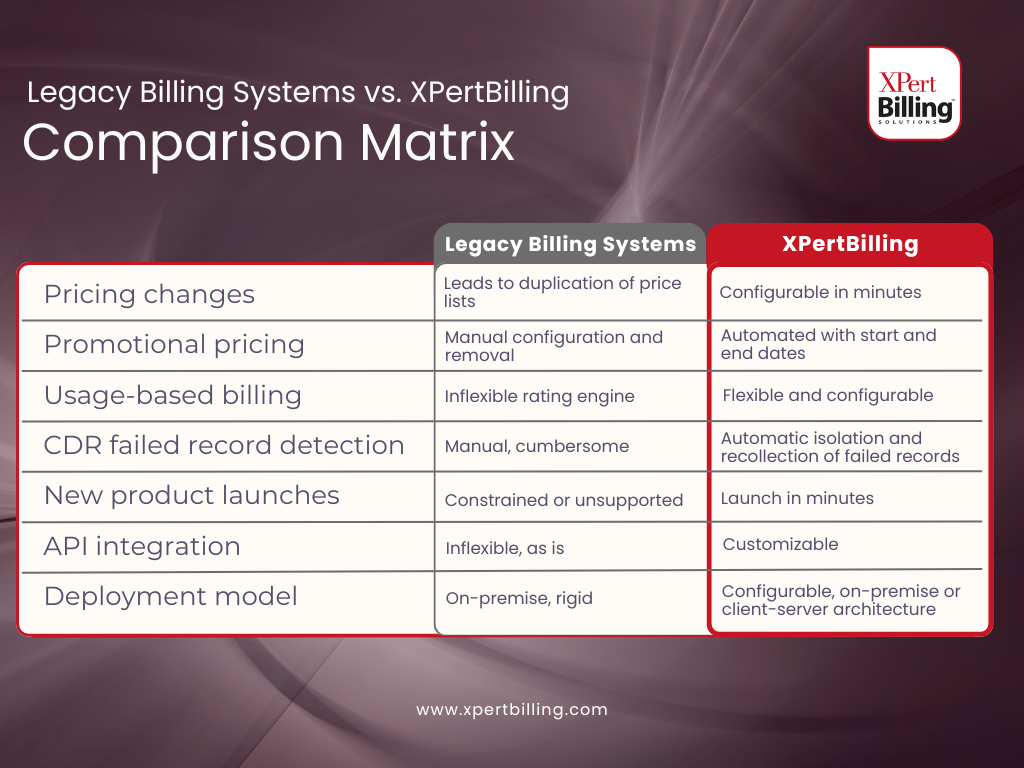
The Billing Agility Framework: 6 Capabilities That Remove the Bottleneck
Billing agility is the ability to configure, launch, and modify billing operations in response to business needs without requiring custom development or engineering resources for every change. An agile billing system allows finance or operations teams to create new pricing tiers, set promotional rates with automatic expiry, and bundle services without custom development. It is the difference between a billing system that enables product velocity and one that constrains it.
It's composed of six core capabilities:
1. Configurable rate structures
A billing engine built for flexibility lets operations or finance teams modify pricing rules, create new tiers, and adjust rate structures through quick configuration rather than code. When a new bundle is conceived on Monday, it should be billable by Friday, not next quarter.
2. Dynamic promotional pricing with automatic reversion
Limited-time offers should be a core built-in capability of the billing system, not a manual process. The system should support start and end dates for promotional rates, with automatic reversion to standard pricing when the promotion ends. No intervention required. No risk of customers being billed at the wrong rate after a campaign finishes.
3. Converged and split invoicing
Modern businesses serve modern customers: enterprises that need department-level cost allocation, shared data pools across a corporate mobile plan, or IoT deployments where charges are distributed across device types or tenants. A capable billing system handles both convergence and splitting as standard features.
4. Usage-based billing at scale
As consumption-based pricing becomes the norm across SaaS, telecom, and IoT, the billing engine needs to process high volumes of usage data, e.g., call detail records (CDRs), transaction data records, API calls, data consumption, accurately and at scale. Errors at this layer are invisible until they become disputes, and disputes at scale become a revenue and retention problem.
5. API-first integration
The billing system should connect bidirectionally with CRM, ERP, and analytics platforms so that pricing changes propagate automatically, invoices flow directly into finance systems, and customer data stays synchronized. Integration complexity is one of the biggest hidden costs of legacy billing infrastructure.
6. Automatic CDR error detection and isolation
In high-volume billing environments, bad data is inevitable. The question is whether the system catches it automatically or passes it through to invoices. A billing system that can automatically detect, isolate, and flag the failed CDR records without rejecting an entire file, and can re-collect only the affected records once your configuration is corrected, significantly reduces processing time and administrative effort while maintaining the integrity of your data.
A modern billing engine such as
XPertBilling is a critical component of your operational infrastructure and growth that can give your product, finance, marketing, and operations teams the ability to respond to market opportunities faster and the agility to innovate without being constrained by billing limitations.
Making the Case for Change Internally
Organizations often know their billing system is holding them back before they're willing to act on it. The investment feels large. The disruption of migration feels daunting. So the default is inertia.
There are three reframes worth taking into leadership discussions:
The cost of inaction compounds.
Every quarter spent on a system that can't support the business is a quarter of foregone product launches, manual workarounds, and billing disputes.
Modern billing doesn't mean rip-and-replace.
Billing engines built with open APIs and standard integration patterns can layer into your existing tech stack without requiring a full system migration. Deployment timelines are often far lower than organizations expect, particularly when the vendor has deep experience in the specific vertical.
Billing agility has a direct, measurable impact on revenue. Every new product that ships on time, every promotional campaign that executes without errors, every customer who receives an accurate and transparent invoice, each of these is a direct result of billing infrastructure that works.